Horizon's internal assessment is accurate on commercial structure and honest on two real limitations. It is wrong on the four claims that matter most: attribution methodology, deduplication, measurement basis, and scalability ceiling. This memo answers each directly, with what's actually in the stack.
No defensiveness on these. They're real, current, and worth naming plainly before the corrections below.
No offline or physical-retail conversion path today.
A genuine gap for omnichannel brands with in-store sales. Not disputed.
Agentic optimization currently recommends. It does not yet execute buys automatically.
Publisher and deal-ID moves are surfaced to a human, not auto-executed. Roadmap item, not shipped.
The commercial model is CPM buying with a CPA guarantee, margin captured on the spread.
Correctly described. Standard for guaranteed-performance CTV. Nothing to correct here.
These two gaps are exactly why this is a partnership and investment conversation, not a vendor pass/fail.
A company with the measurement infrastructure shown in Sections 02 through 06, that is still early on offline conversion capture and automated execution, is a growth-stage build, not a ceiling. The right capital and the right enterprise partner close exactly those two gaps. That is the opportunity in front of Horizon, not a reason to walk.
Each pairing below is the memo's language on the left, the actual mechanism on the right.
Treats VisionBridge as a single self-reporting layer built only to justify the CPA buy.
Attribution is one of three documented pillars, not the whole product. A statistical MMM baseline allocates credit independent of the CTV buy, and registered holdout tests measure incremental lift against a true control group — the exact causal-inference discipline the memo says is missing. If it wasn't shown in the room, that's a gap in the meeting, not the platform.
Frames dedup as a capability that fails once media mix broadens.
Cross-channel suppression against Meta, Google, and existing-customer history, before any CTV credit is issued, is the entire reason the product exists. Double attribution is the problem it was built to solve. It's the first check on every order, not a limitation that appears at scale.
Implies the guarantee ledger is built on the same fragile layer as journey visualization.
UTMs and log files support journey visualization only. The guarantee ledger is built on deterministic order-ID matching against the client's own commerce data — a separate, harder layer than the one being critiqued.
Frames the offering as pricing structure without a real technical edge.
Impression-level CTV exposure streams directly into Meta's retargeting layer. That collapses average time-to-conversion from 50-plus days to under 3. That's a running pipeline, not a pricing structure — and it's the one differentiator the assessment didn't mention.
Horizon's own enterprise-complexity framing, reworked against what's actually true of each factor.
| Enterprise factor | Horizon's claim | Corrected |
|---|---|---|
| Broader media mixes & brand investment | VisionBridge only justifies programmatic media, doesn't evaluate holistic incrementality | MMM baseline plus registered holdout tests already measure incrementality independent of the CTV buy — see Section 02. |
| Multi-agency ecosystems | Coordination and dedup break down without independent enterprise measurement | Cross-channel dedup against Meta, Google, and customer history is the founding mechanism, not a scale failure point. |
| Offline sales & omnichannel tracking | UTMs and log files can't support offline or physical-retail paths | Conceded as-is. Real gap today. Billing itself does not run on UTMs (see Section 02), but offline conversion capture is not yet built. |
| Measurement philosophy | Causal inference and MMM directly conflict with self-justifying attribution | MMM and holdout testing are the measurement philosophy already in place. The conflict the memo describes doesn't exist in the current build. |
This is the technical breakthrough the assessment says doesn't exist. CTV impressions aren't a silo that gets reported on after the fact — they feed Meta's audience layer in real time, collapsing the gap between exposure and purchase from a month and a half down to under three days. Every other claim in this memo is defensible on paper. This one is visible in the account the moment it's turned on.
The Boost Mobile x VisionBridge launch plan and attribution methodology, dated August 11, 2026, puts the operating rules, validation dependencies, and platform plumbing in writing before scale.
The concern is that the system can loosely credit itself after the fact, with no defined basis for the decision.
Credit is allocated only to the pre-click touchpoint: the impression that ran before a platform click. Anything after that click receives zero attribution credit. The final thresholds, including haircut percentages and credit-share splits, are configurable and open to Boost’s input before launch. That is a conservative, defined, negotiable ruleset, not an elastic one.
The assessment treats external validation and cross-platform operating capacity as missing prerequisites for serious scale.
MRC accreditation and independent LTV benchmarking are named dependencies before spend scales. At the same time, platform connector access across The Trade Desk, Meta, Google Ads, and DV360 is confirmed and ready to run through the API pipeline. This is a national telecom pilot trafficking programmatic activity across four major platforms simultaneously, not a small-DTC-only workflow.
The assessment assumes untested audience theories are being presented as proof.
Device-tenure targeting is explicitly labeled a hypothesis to be tested, not a proven segment. Formal three-month and six-month post-acquisition checkpoints measure retention, product attach, and upgrade or downgrade signals. Labeling an unproven segment as unproven is the methodological rigor and intellectual honesty the assessment says is missing.
Frøya's CTV lift study is not a VisionBridge self-report. It ran a clean 37-state versus 13-state holdout, then extended it to a 90-day national rollout, cross-validated by two independent geo-lift methodologies: Haus.io and Measured.com. Full report: froyatest.visionbridgetv.com
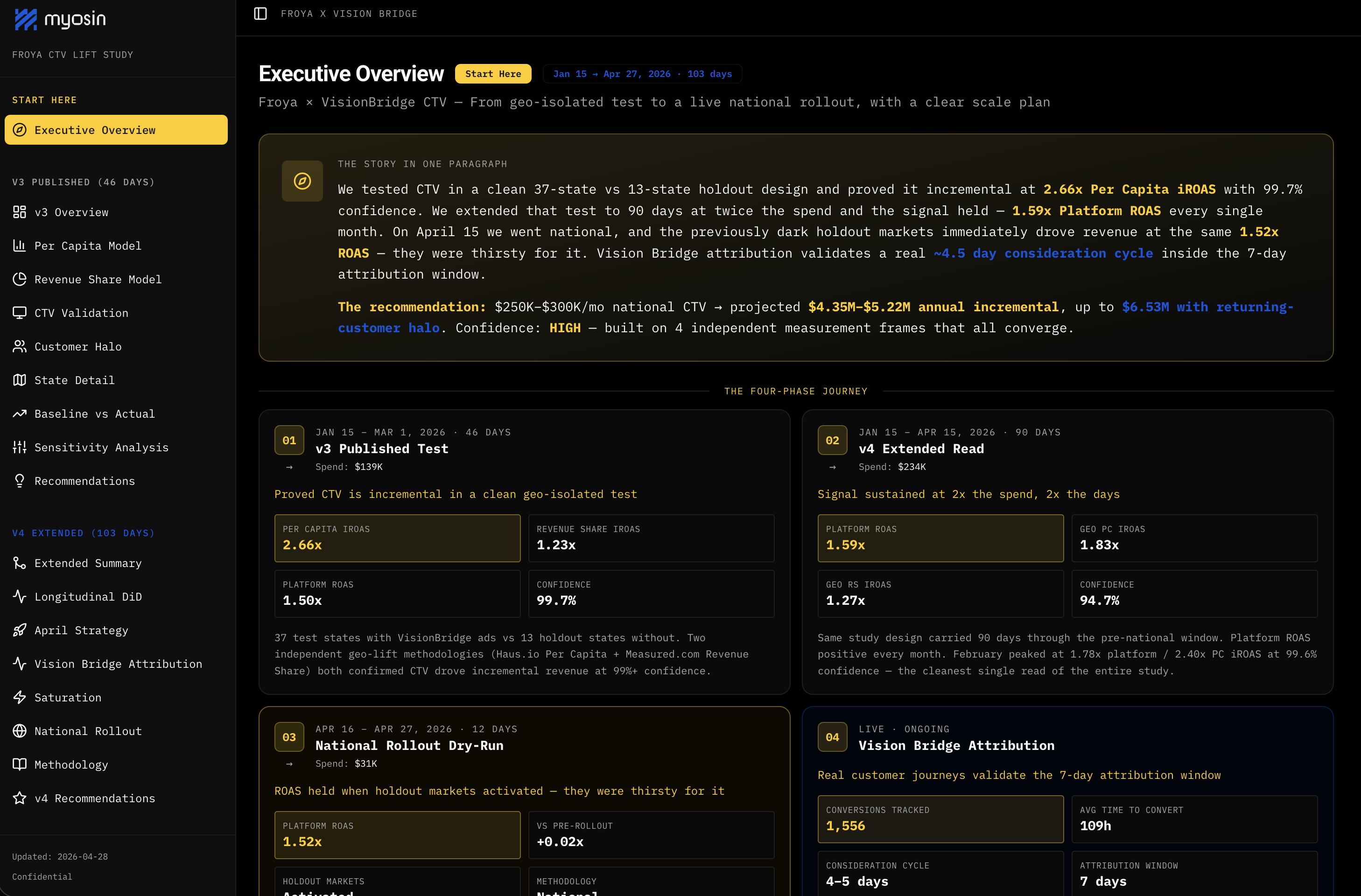
2.66x Per Capita iROAS, 99.7% confidence.
37 test states vs. 13 holdout states, no VisionBridge ads. Two independent methodologies, Haus.io Per Capita and Measured.com Revenue Share, both confirmed incrementality.
Signal held at 1.59x Platform ROAS, 2x the spend, every month.
Same design carried through the pre-national window. February peaked at 1.78x platform ROAS at 99.6% confidence, the cleanest single read of the study.
1.52x ROAS held the moment holdout markets went live.
Vision Bridge attribution independently validates a ~4.5 day consideration cycle inside the 7-day attribution window, across 1,556 tracked conversions.
Four independent measurement frames that converge on the same answer is the causal-inference discipline the assessment says is absent. It is running, published, and dated.
The commercial description in Horizon's assessment is accurate, and the two conceded limitations in Section 01 are real, and exactly why this is a partnership and investment conversation. The corrections in Sections 02 through 06 aren't a matter of interpretation. They're what's running in the account today, independently validated by two outside measurement firms. The right next step is putting the measurement lead in a room with Michael, Kevin, and Katie to walk through the holdout design, the dedup logic, and the MMM layer directly, rather than settling it in writing.